
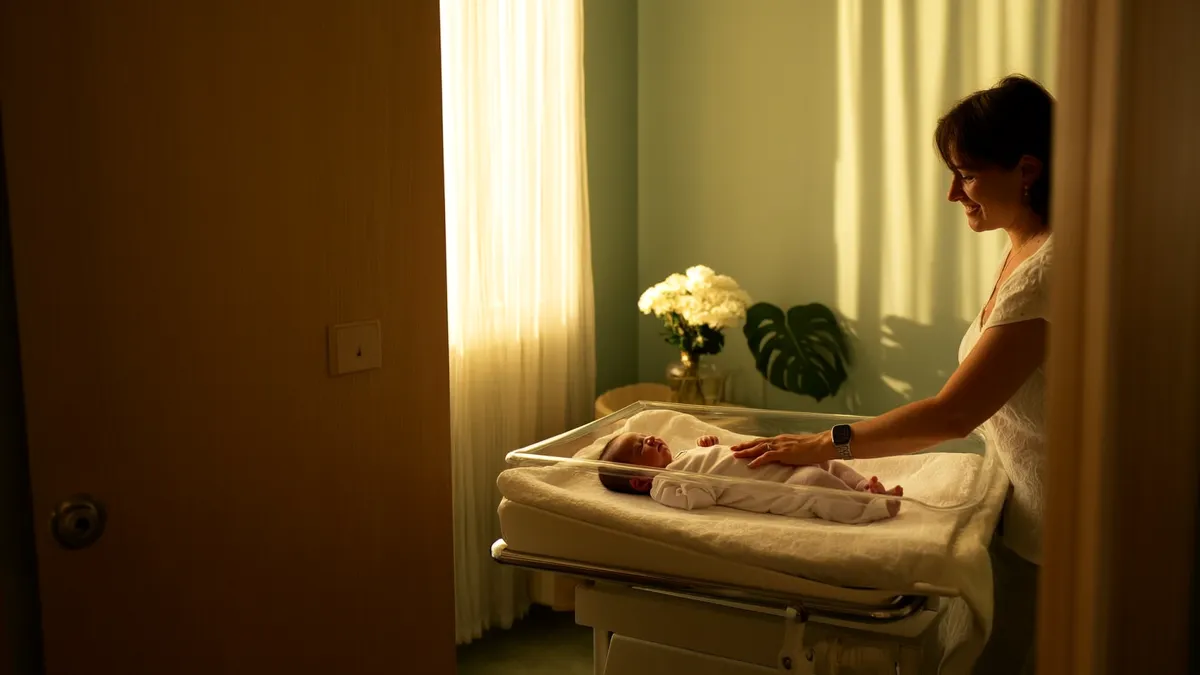
What happened after Riley was born?
Riley Hochstetler was born on January 29, 2025, in Indiana, USA, to first-time mother Jeannie Hochstetler, 28. Despite a smooth, complication-free pregnancy, Riley did not cry at birth. Doctors rushed him onto oxygen, and his mother later recalled watching a physician stand over him — chin resting in hand — for hours, clearly troubled but unable to explain why.
What signs pointed to something serious?
Beyond the silence at birth, Riley showed several alarming physical traits: small hands with webbed fingers, absence of the right pectoral muscle, and a jaw that could barely open. He was placed on CPAP support and fed through a nasogastric tube. He spent several weeks in the neonatal ICU while doctors worked to identify his condition.
What is Poland-Moebius Syndrome?
At three weeks old, Riley was officially diagnosed with Poland-Moebius Syndrome — a rare congenital condition combining two separate disorders. The U.S. National Institutes of Health (NIH) estimate that Moebius Syndrome occurs in roughly 1 in every 50,000 live births. It results from underdeveloped facial nerves, affecting facial expressions and eye movement. Poland Syndrome, often associated with Moebius, causes absence or underdevelopment of chest muscles.
What challenges can people with this condition face?
- Difficulty swallowing and speech problems
- Inability to smile or frown
- Hearing loss
- Delayed motor development
- Limited eye movement
How did the family cope with the diagnosis?
When Riley was transferred by helicopter to a larger NICU three hours away — just two weeks after his birth — Jeannie described it as "quite the introduction to motherhood." She had never heard of either syndrome before and faced deep uncertainty about her son's future. Despite the shock, the family began sharing their story publicly to raise awareness of these ultra-rare conditions.
- Riley was born January 29, 2025, in Indiana, USA
- Diagnosed with Poland-Moebius Syndrome at 3 weeks old
- Moebius Syndrome affects approximately 1 in 50,000 live births (NIH)
- Condition causes facial paralysis and underdeveloped chest muscles
- Riley required CPAP, nasogastric feeding, and two NICU transfers
💬 Comments
Sign in to comment and like